
 PharmaChem Cosmetics Industries
 PharmaChem Cosmetics Industries
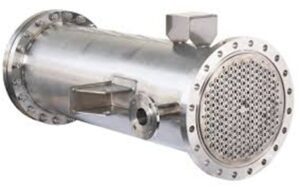
 is a leading shell tube heat exchanger Manufacturers in India is a device used to reduce gas or vapour into liquid by removing heat through efficient heat transfer. Widely used in power plants, refrigeration systems, petroleum refineries, and chemical industries, the shell tube heat exchanger condenses vapours such as steam, refrigerants, hydrocarbons, and chemical vapours. The basic working principle of a shell tube heat exchanger involves transferring heat from a hot fluid to a cooler medium, causing the vapour to lose heat and convert into liquid, a process known as condensation.
In a shell tube heat exchanger, one fluid flows through a bundle of tubes while another fluid flows around the tubes inside a cylindrical shell. Heat is transferred across the tube walls without direct contact between fluids, ensuring safe and controlled operation even at high pressures and temperatures. Heat-conductive materials like copper, stainless steel, and carbon steel are commonly used to enhance thermal efficiency and durability.
The shell tube heat exchanger offers high efficiency, robust construction, easy maintenance, and the ability to handle large flow rates. Features such as fins, baffles, and cooling media like air or water further improve performance. Due to its reliability and versatility, the shell tube heat exchanger is one of the most preferred heat transfer solutions in industrial heating, cooling, and condensation applications.
In a shell tube heat exchanger, one fluid flows through a bundle of tubes while another fluid circulates around the tubes within a strong cylindrical shell. Heat is transferred efficiently across the tube walls without any direct mixing of the two fluids, which ensures safe, clean, and controlled operation. This indirect heat transfer method allows the equipment to perform reliably even under high pressure and high temperature conditions, making it suitable for demanding industrial processes. To maximize heat transfer efficiency and ensure long service life, heat-conductive materials such as copper, stainless steel, and carbon steel are commonly used. Copper provides excellent thermal conductivity, while stainless steel and carbon steel are preferred for their strength, corrosion resistance, and compatibility with chemical and pharmaceutical applications.
The shell tube heat exchanger is known for its high thermal efficiency, rugged construction, and operational flexibility. Its design allows it to handle large flow rates and significant temperature differences with minimal performance loss. Components such as baffles inside the shell direct fluid flow across the tubes, increasing turbulence and improving heat transfer efficiency. In some designs, fins are added to increase surface area, further enhancing heat exchange. Depending on the application, air, water, or other cooling or heating media can be used to achieve precise temperature control.
Another major advantage of the shell tube heat exchanger is ease of maintenance. Its modular design allows for easy inspection, cleaning, and replacement of tubes, which reduces downtime and operating costs. Because of its reliability, durability, and wide range of configurations, the shell tube heat exchanger is extensively used in industrial heating, cooling, and condensation applications across power plants, chemical processing units, refineries, pharmaceutical manufacturing, and food processing industries.
Type: Shell & Tube Condenser
Application: Vapour condensation / heat removal
Heat Transfer Area: As per process requirement
Design Pressure:
Tube Side: Up to 10–25 kg/cm² (customizable)
Shell Side: Up to 10–25 kg/cm² (customizable)
Design Temperature: Up to 200–300°C (as required)
Operating Medium:
Hot Side: Vapour / Steam / Process Gas
Cooling Side: Water / Air / Brine
Tube Material: SS 304 / SS 316 / Copper / Carbon Steel
Shell Material: Carbon Steel / SS 304 / SS 316
Tube Size: ½”, ¾”, or 1” OD
Tube Length: As per design
Tube Layout: Triangular / Square pitch
Baffles: Segmental / Disc & Doughnut
No. of Passes: Single or Multiple
Flow Arrangement: Counter-flow / Parallel-flow
End Connections: Flanged / Threaded / Tri-clamp
Mounting: Horizontal / Vertical
Surface Finish: Internal mirror / external matt
Leak Testing: Hydro / Pneumatic test
Standards: ASME / TEMA / GMP (if applicable)
Accessories: Vent, drain, thermometer pocket, pressure gauge
Maintenance: Easy tube bundle removal and cleaning